Your PECO Bill Explained: Where Your Money Really Goes
Why Your Bill Feels Heavy
Your PECO bill isn’t like other bills. You can cut a subscription or eat out less, but you can’t skip electricity. And unlike most expenses, it seems to rise every year.
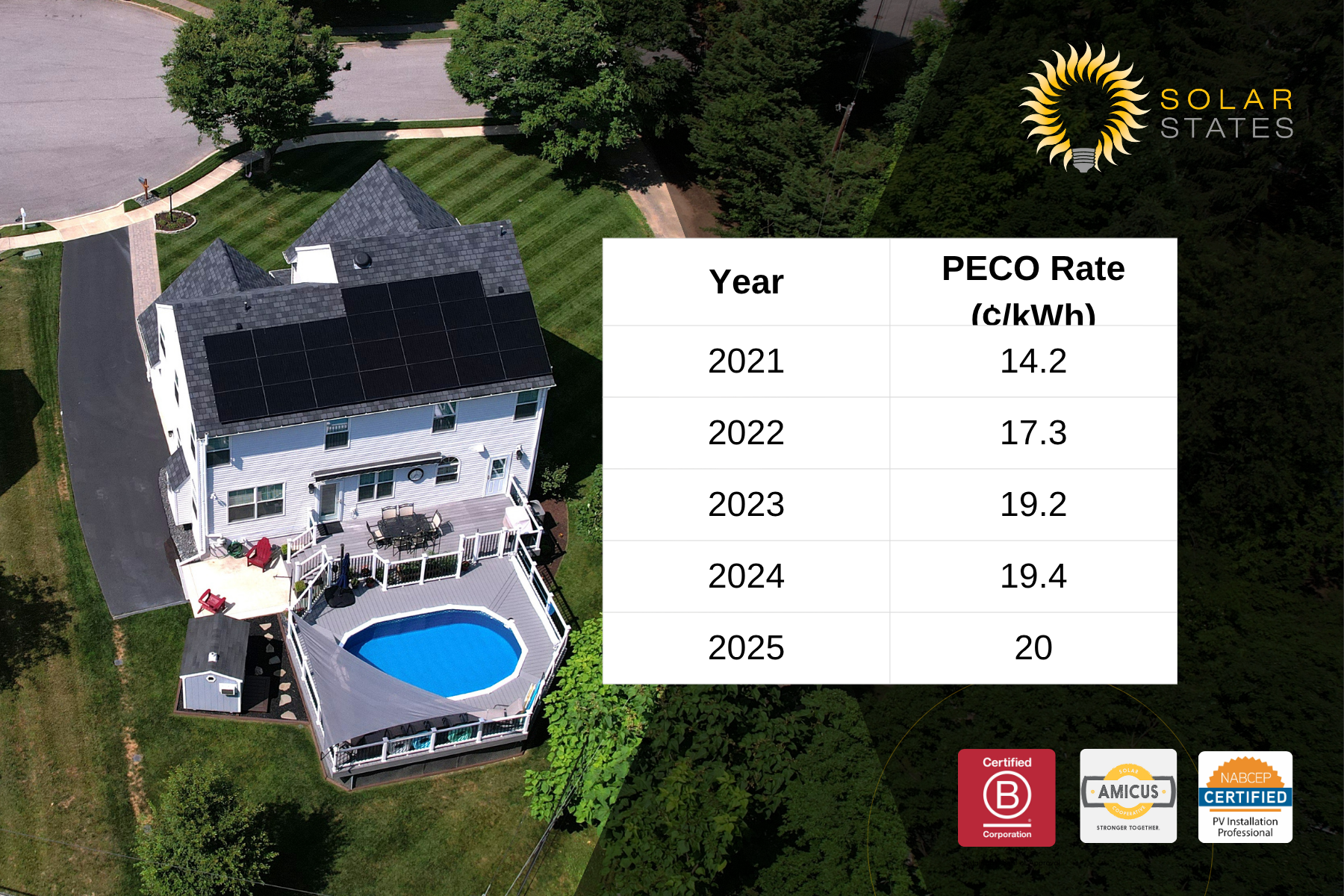
As of mid-2025, PECO’s residential electricity rate has climbed to 20.1¢/kWh. Just five years ago, it was 13.6¢/kWh — nearly a 50% increase. For the average Philadelphia household using about 1,000 kWh/month, that means today’s electric bill is around $200/month — compared to about $135/month in 2020.
So where does that money actually go? Let’s break it down.
The Two Big Buckets
Every PECO bill is divided into two main categories:
-
Delivery Charges → The cost of moving electricity through poles, wires, transformers, and the local grid. These are regulated fees PECO collects for infrastructure.
-
Supply Charges → The cost of generating and transmitting electricity, whether PECO procures it or you shop for another supplier.
👉 Even if you choose a different supplier, PECO is still the only company allowed to deliver electricity in this region. Delivery charges are unavoidable.
Delivery Charges – Getting Power to Your Home
Delivery is the “wires and service” side of your bill. For a household using 1,000 kWh in a month, typical delivery costs might look like this:
-
Customer Charge: A fixed fee of about $11/month just to maintain your account.
-
Distribution Charges: Around 9.6¢/kWh, which comes to $96 for 1,000 kWh.
-
System Improvement Fees & Riders: Small surcharges (around $1–2/month) to fund grid upgrades.
💡 Together, delivery adds up to roughly $110/month for a typical household — before even buying electricity.
Supply Charges – The Electricity Itself
Supply is what you pay for the actual power. At current rates, supply is split into two parts:
-
Generation: The cost of producing electricity. Around 9.5¢/kWh, or about $95 for 1,000 kWh.
-
Transmission: The cost of moving power across the regional PJM grid into PECO’s system. This typically adds $8–10/month.
That means supply totals roughly $105/month for a typical household today.
Taxes & Assistance Programs
On top of delivery and supply, bills also include:
-
Taxes: The state gross receipts tax, usually around $15–20/month depending on usage.
-
Customer Assistance Programs (CAP): Income-qualified households may get bill reductions. These are funded across all PECO customers.
-
Budget Billing & Efficiency Rebates: Options to smooth costs or reduce usage.
The Bigger Picture – What Rising Rates Mean for You
Put it together, and the average Philadelphia household using 1,000 kWh/month pays about $230/month in 2025. But here’s the challenge: utility rates almost always rise. Let’s project a 3% annual increase (a conservative estimate based on past trends).
-
Today (2025): $230/month → $2,760/year.
-
In 5 years (2030): ~$267/month → ~$3,204/year.
-
In 10 years (2035): ~$310/month → ~$3,720/year.
-
In 15 years (2040): ~$360/month → ~$4,320/year.
Over 15 years, that’s more than $55,000 spent on electricity — and all of it goes to PECO.
Why Solar Changes the Equation
PECO’s charges rise because they’re tied to infrastructure investments, fuel costs, and market auctions. Customers have no say — they simply pay whatever rates are set.
Solar flips that equation. Once installed, your system produces power at a stable, predictable cost. Instead of watching rates rise 3% or more each year, you’re essentially locking in today’s prices for decades.
This isn’t just about saving money in year one. It’s about avoiding tens of thousands in future costs and keeping those dollars in your household, not the utility’s pocket.
Conclusion
Your PECO bill is more than a single number. It’s a mix of delivery fees, supply charges, and taxes — all of which have steadily risen.
Now you can see how the math works: what feels like a $200 bill today adds up to tens of thousands of dollars over time.
With solar, you can redirect those unavoidable costs into your own clean energy system, creating stability and control for the long run.
🙂 No Gimmicks. No Pressure.
Submit the form below to get your free quote and find out “How much will this cost?” “How much can I reduce my electric bill?” “What will the system look like?” “What are my payment options?” + any other questions you may have.
Say Hi.

About Solar States – DE, PA, NJ, MD
Solar States is a solar installer and educator based in Philadelphia, Pennsylvania. We are a certified B-Corp and Best for the World Nominee in both 2018 and 2019. We can install solar on any roof – residential or commercial – in Delaware, Pennsylvania, New Jersey, or Maryland. If you have any questions about a transition to a sustainable energy system for your property, we can answer them.
Trusted by homeowners, businesses, and non-profits: