Micah's System
Solar States Founder Micah Gold-Markel has gone solar again. “How does the veteran solar man design his own system, and why?” We traveled 10 feet to his office to ask, and here’s what our reporters heard:
Project Overview
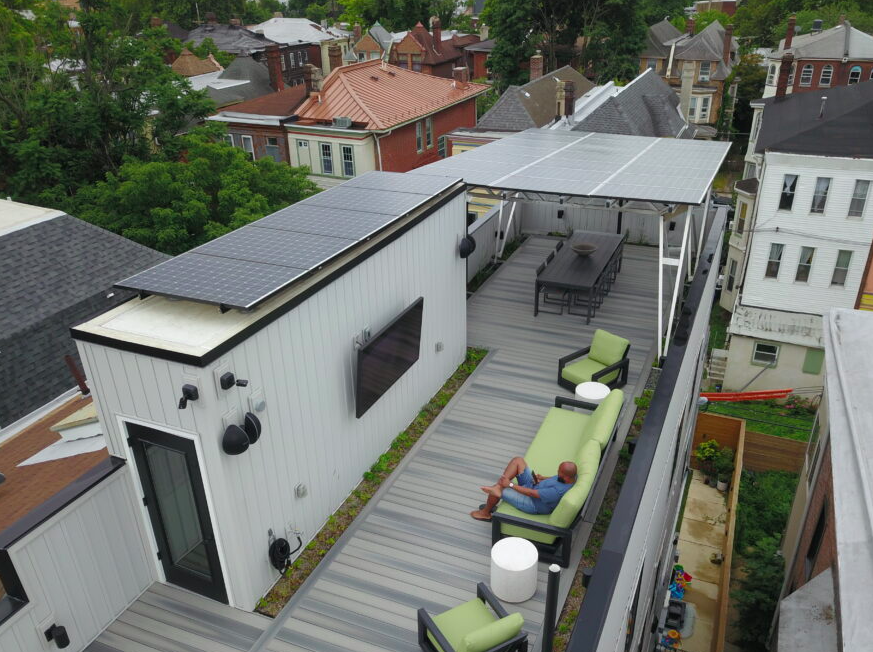
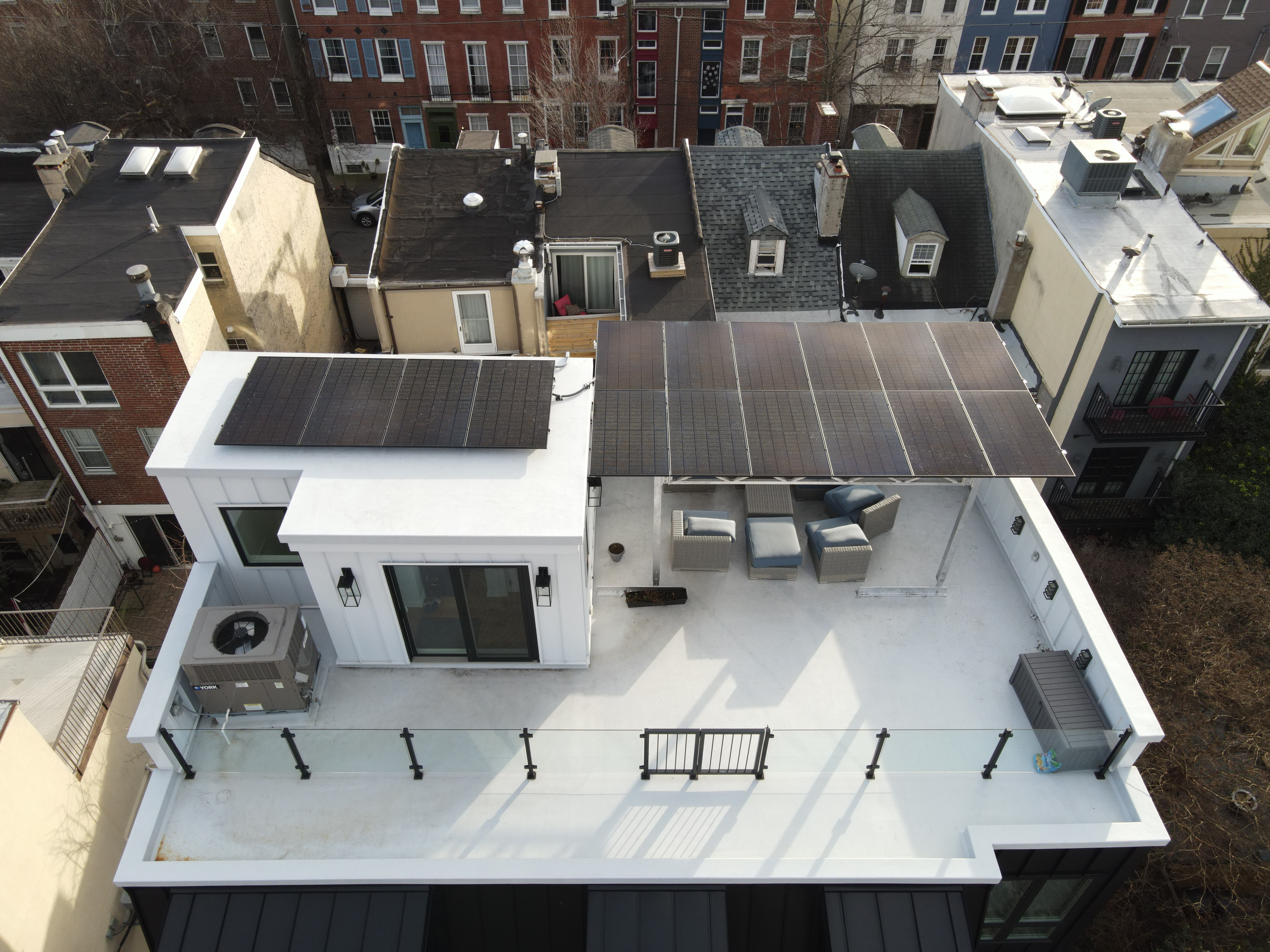
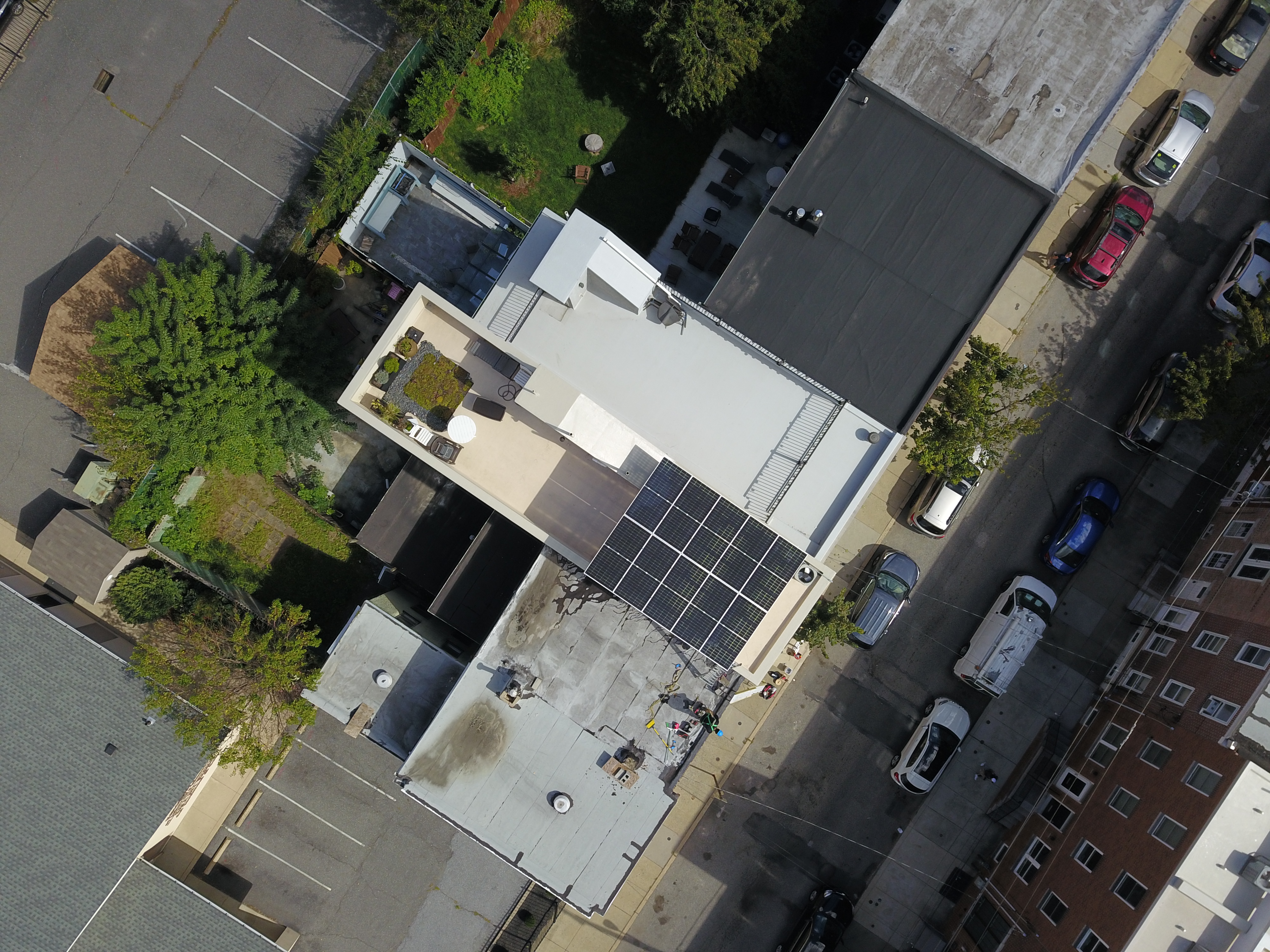
Micah’s home system is a 5.3 kW rooftop solar canopy built with LG bifacial silver-framed 440-watt modules mounted on a Brooklyn Solar Canopy structure. Big shout out to T.R., Gaelen, and the team at Brooklyn Solar – long-time friends of the company, fellow city-based solar installer.
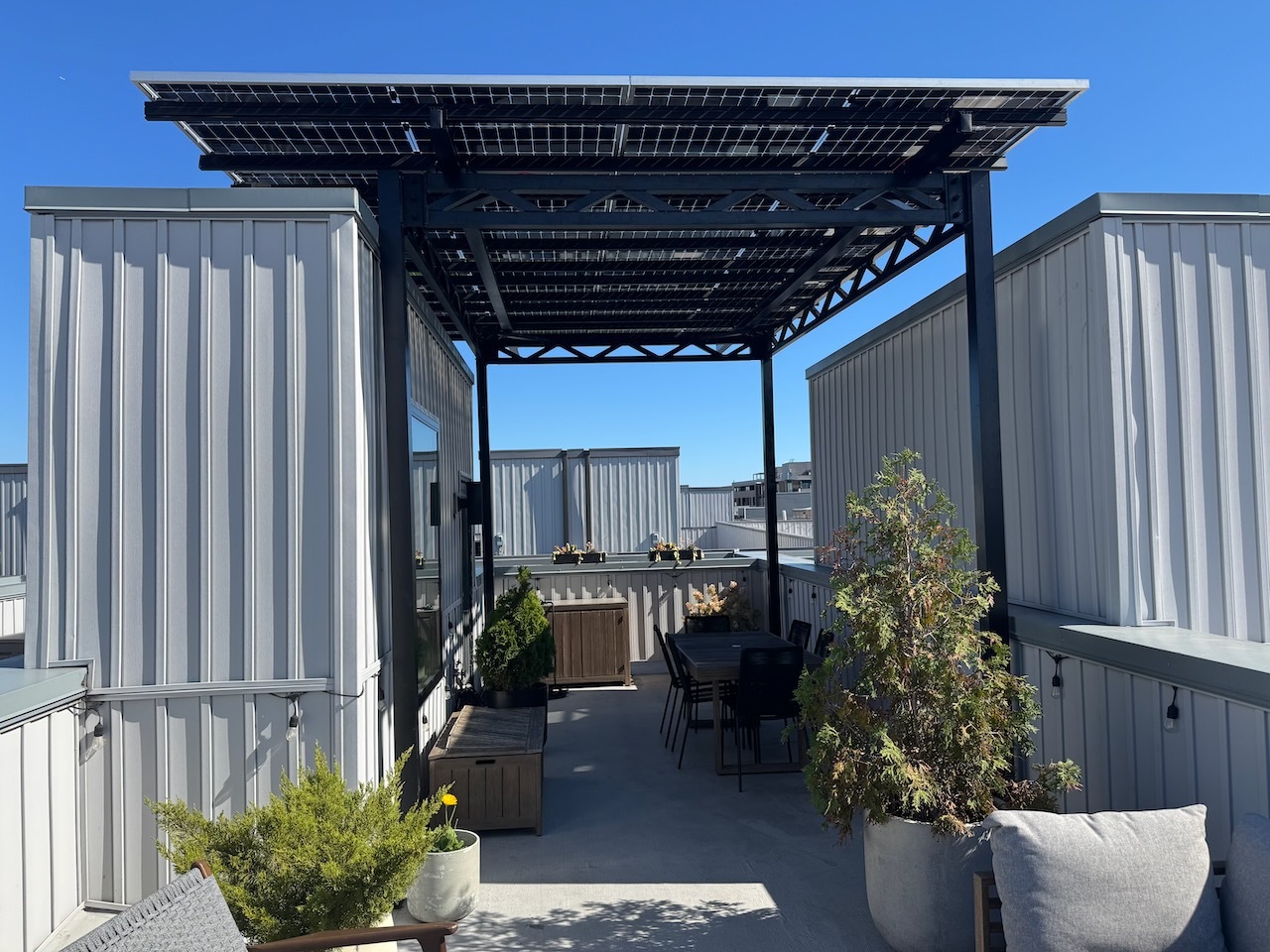
The canopy uses a single-leg, powder-coated black design rather than the typical A-frame, giving it a clean, architectural appearance while maximizing deck space. Keyword there is CLEAN.
Of course…Micah had to do it the hard way. His decision to exceed the standard 9-foot zoning height limit—ultimately reaching 12 feet—was intentional, both for clearance above the pilot house, to prevent the solar array from being shaded, and to preserve an open, shaded, usable rooftop environment.
Although the added height required a zoning variance, the extra effort paid off: the canopy doubles as a shaded pergola that widens the use window during the summer and transforms the deck into a functional outdoor dining and relaxation space surrounded by plants. While it just feels cooler—no hard data to back that up (yet..) —the aesthetic effect is undeniable. The bifacial modules’ transparent backsheet lets sunlight filter through, creating a dappled-light pattern that Micah particularly likes. Clean, clean, clean. Say it with us.

Zoning and Permitting Journey
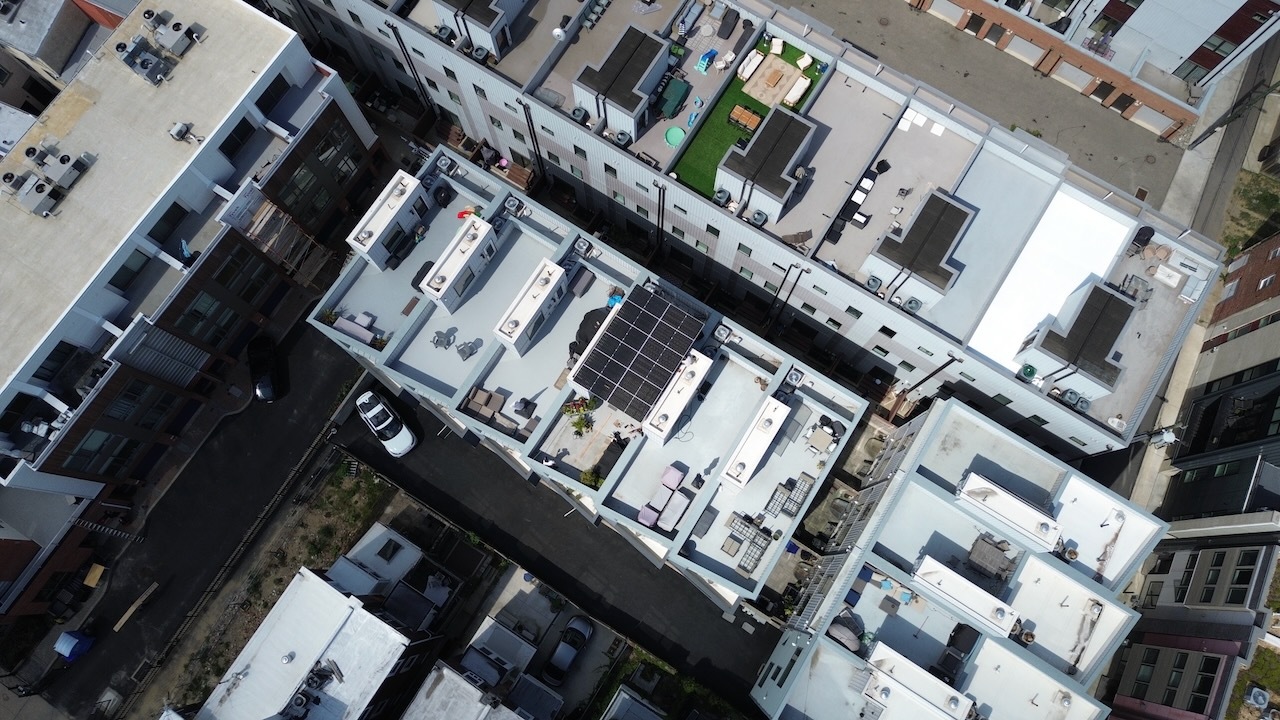
What could have been a standard installation became a two-year process due to the need for a zoning variance. Micah first applied for a building permit, fully expecting to be denied—a zoning variance requires a rejection. He used that formal rejection to petition the variance. He presented to the Northern Liberties Neighborhood Association (NLNA) zoning committee, explaining the design and its minimal impact on neighbors. The committee was supportive, and after receiving their endorsement, he presented before the Philadelphia Zoning Board of Adjustment (ZBA) to secure final approval. Once granted, he reapplied for permits and renewed his interconnection agreement, coordinating materials and timing with installers.
Technical Composition
Micah’s system details:
● Total system size: 5.28 kW
● 12x 440-watt LG bifacial panels on a Brooklyn Solar Canopy (12 ft height, black powder-coated steel, single-leg structure)
● Two Tesla Powerwall 3s for energy storage (Tesla Powerwall 3s include the inverters, which is why Tesla systems are often cheaper)
● A Span smart electrical panel with microgrid initiation device (MID) serving as a virtual critical-loads panel
● A custom data connection (Cat-6 line) linking Span and Tesla to exchange energy-use data
To get the system working without full off-grid functionality, Micah additionally had to add a Tesla consumption meter that would allow the batteries to know when the grid went out. That functionality is typically included in the Tesla Gateway—but he skipped it.
In order to go off-grid, you have to disconnect from the grid: the rules for powering your house when the grid is out mean that the house must be disconnected from the grid—no possibility of feeding back, purely a safety mechanism. You accomplish that with the MID (microgrid initiation device), or a transfer switch, that says “no voltage? Switch off and isolate the grid.” That’s the functionality of the Gateway, but the Span panel also has that capability! The integration that isn’t working yet is the ability for the Span panel to say “I went off-grid.”
Everybody thinks about going off-grid, but as Micah says, “It’s actually inconsequential in the city.” The more important functionality is the Time-of-Use rate manipulation. In a rural area—like Micah’s Powerwalls in Massachusetts that perform in a VPP—they’re mainly for off-grid use because there are so many grid outages.
Micah is on the edge, ‘tip-of-the-spear’ as our colleague Todd Baylson would write, with what he did integrating Span communication with Tesla Powerwall. The software integration with Span will come out with full integration soon.
Energy Monitoring & Insights
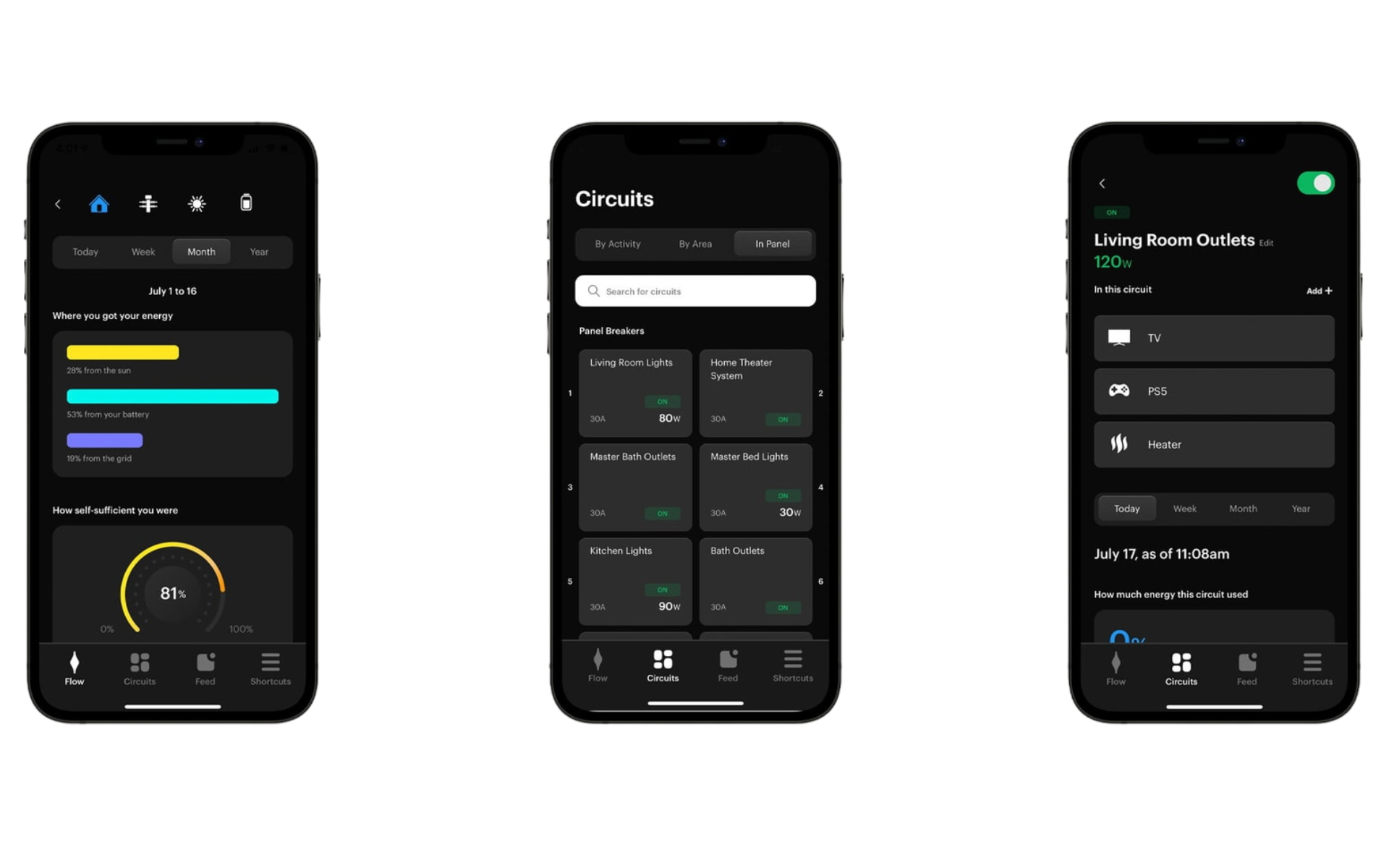
Through the Span app, Micah can see circuit-level energy data—from largest to smallest loads—and review net grid usage, solar generation, and daily household consumption. The key insight for Micah from the Span panel was realizing that the car draws 5x more than anything else. This level of visibility revealed several surprising energy draws:
• A radon mitigation fan, which runs continuously and consumes far more energy than expected
• A sump pump, which cycles periodically and contributes significant hidden load
• Typical temperature-control and appliance usage, plus an EV charger, which is by far the largest single draw
Because we’re at the end of summer, Micah hasn’t tested the Powerwalls under two AC loads yet, but because he knows the loads from Span, he knows what to expect.
The Span interface made it possible to visualize and quantify these loads, enabling smarter scheduling and prioritization.
Time-of-Use Optimization
Micah transitioned to PECO’s Time-of-Use (TOU) rate structure, which dramatically shifts energy costs between off-peak and on-peak hours:
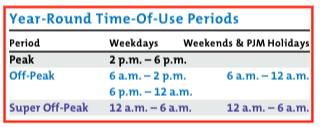
• Super-off-peak: midnight–6 a.m., 4.9¢/kWh
• Off-peak: 6 a.m.–2 p.m. and 6 p.m.–midnight (weekdays), 7.05¢/kWh
• Peak: 2 p.m.–6 p.m. (weekdays only), 29.7¢/kWh
The rate differential created a massive opportunity for cost savings through strategic load shifting. Micah programmed his Tesla to charge overnight during super-off-peak time periods while using the Powerwalls to cover off-peak and peak hours. However, he discovered a software bug in Tesla where he had to manually input TOU rates and times. Additionally, PECO’s online enrollment returned an error, adding to the troubleshooting process.
First Month Results: Strategy Validated
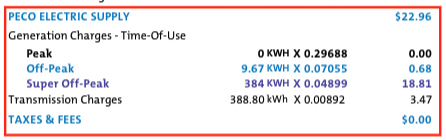
Micah’s first PECO bill under Time-of-Use rates arrived in November 2025, covering October 24 through November 18—and the numbers proved his optimization strategy works even better than anticipated.
The Results:
• Total grid consumption: 389 kWh over 25 days (15.6 kWh/day average)
• TOU breakdown:
– Peak (2-6pm weekdays): 0 kWh—completely eliminated
– Off-Peak: 9.67 kWh (2.5%)
– Super Off-Peak: 384 kWh (98.7% of all grid draws)
• Total bill: $71.80
• Effective rate: ~18.5¢/kWh (blended across all charges)
Micah was particularly proud to point out the core economics: “Solar offset my consumption by about 50%, but the TOU rates cut my costs by 60-70%. That’s the whole game—it’s not just about using less energy, it’s about when you use it.”
To understand the impact, consider what happened compared to the same period last year:
• Last year (same period): 881 kWh at standard residential rates (17.5¢/kWh, which went up to 20¢/kWh in the 2025 bill) = $167
• This year: 389 kWh at optimized TOU rates = $71.80
The math breaks down into two layers of savings:
1. Solar generation reduced consumption by approximately 50% (from ~880 kWh historical average to 389 kWh grid draw)
2. TOU optimization compressed nearly all remaining grid usage (99%) into the cheapest rate windows, avoiding the 29.7¢/kWh peak charges entirely
The result: Micah achieved a 56% reduction in total consumption and an estimated 60-70% reduction in electricity costs compared to his pre-solar usage patterns.
“The batteries aren’t just backup power,” Micah explained. “They’re a cost arbitrage tool. I’m essentially buying electricity at 5 cents and avoiding purchases at 30 cents. That’s a 6x cost difference—and that’s where the real savings come from.”
System Integration Philosophy
Micah emphasizes that pairing a smart panel with batteries is essential:
“If you just get batteries, you’re missing half the functionality. The only way to optimize storage is by understanding how your house consumes energy—what every load is doing.”
The Span panel gives him the insight needed to tailor usage, schedule charging, and prepare for true off-grid capability once Tesla and Span finalize their communication protocol. The first month’s bill data proved this philosophy correct: without circuit-level monitoring, it would be impossible to verify that peak usage had been eliminated or to identify opportunities for further optimization.
Family & DIY Element
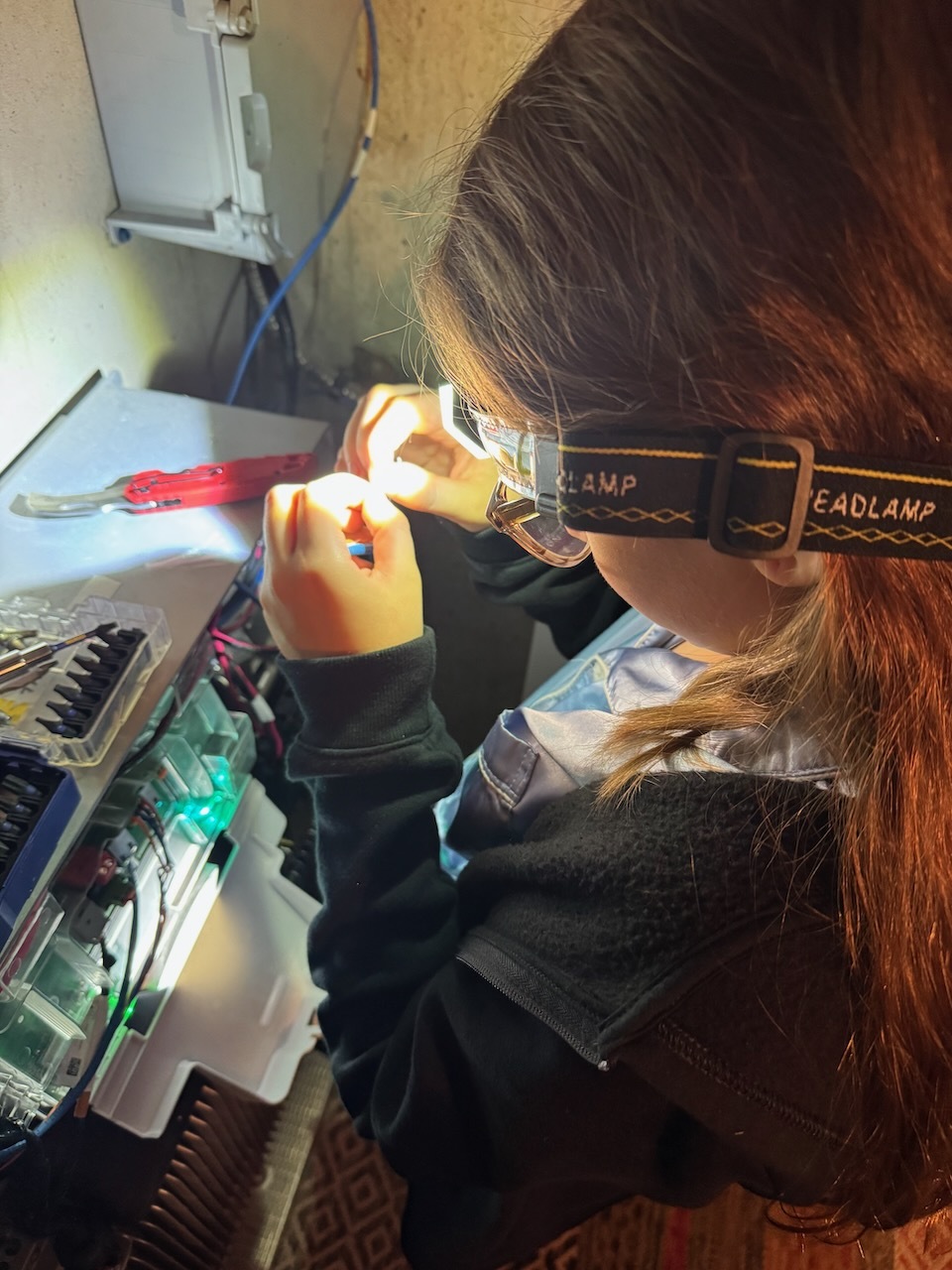
A unique aspect of this project was Micah’s daughter Mira, who helped install the data line connecting Span and Tesla. Using Cat-5/6 cable, she stripped insulation, separated the twisted pairs, arranged them in the correct pinout order, and crimped a male connector—learning real-world electrical and networking skills at age 11. The data link she created enables the system’s partial interoperability and serves as a teaching moment about renewable energy technology.
Everyday Benefits
Beyond the technical and environmental gains, the canopy provides tangible lifestyle improvements:
• Cooler, shaded deck environment for outdoor living
• A visually striking, architectural addition that enhances property value
• A learning platform for understanding how smart homes manage and conserve energy
• Dramatic cost reduction through intelligent energy management
In Summary
Micah’s project is more than a residential solar installation—it’s a case study in integrated home energy management. Through patient navigation of zoning laws, meticulous hardware selection, and persistent troubleshooting across Span, Tesla, and PECO systems, he created a setup that blends performance, aesthetics, and intelligence.
The first month’s results validated the approach: by combining solar generation with strategic battery storage and circuit-level monitoring, Micah didn’t just reduce his energy consumption—he fundamentally changed the economics of his electricity usage. The result is a home that not only generates clean energy but also teaches its occupants how power flows, costs, and comfort can coexist—an experiment in the future of solar-powered living that’s already paying dividends.
Further Viewing
A few years back, a client called to share how he was using solar+batteries+TOU rates to actually get paid by PECO. We went out and talked to him about it, and below is a video of his explanation. Very similar to what Micah is doing. Dave has since sold this home and told the new owner when they bought it: “you don’t pay for electricity here, the utility pays you.”

Also a couple of years old – Micah’s quick overview of Brooklyn Solar Canopies.